
Intro
Why Valsgärde reshaped the picture of the Iron Age
On a low moraine hill east of the Fyris River, barely three kilometres north of the royal mounds at Old Uppsala, lies one of northern Europe’s most important burial grounds. It is not a place that shouts monument — no pyramids rise here, and most graves lack the dramatic barrows seen further south. Yet Valsgärde is a key to how we understand power, war, trade and death in the landscape later called Svitjod.
Valsgärde sits on the river’s eastern bank (about 59.93°N 17.63°E). The hill is part of the Uppsala esker — the ridge that runs through Uppland and once rose as landmarks in a landscape of water, clay and cultivated plain. In the Vendel period and Viking Age it was ringed by field and meadow, still a landmark for anyone travelling by land or river.
The Fyris River was the region’s backbone: transport route, boundary and fairway toward Lake Mälaren, inland to the power centre at Old Uppsala. Whoever controlled the plain and the river controlled the flow of people, goods and information. Elite graves sit right here — in sight of the fairway, yet set apart on their hill.
What made the site world-famous is the fifteen boat graves: clinker-built craft in the gravel, with weapons, helmets, glass, silk, gaming pieces, food and animals. Most were essentially unplundered when Uppsala University excavated them. So we found not only objects — we found scenes. In the published picture those buried in boats are men — roughly one person per generation. That does not speak of a mass warrior class, but of a status only one person at a time could bear.
A typical boat grave follows a recurring pattern: the boat was drawn up from the Fyris and set in a trench in the gravel; the dead lies midships on pillows or a feather bed; weapons and personal gear lie around him; kitchen gear, vessels and food often belong in the bow; horses and dogs lie between the boat and the edge of the trench. These are scenes of power and journey — not only a pile of grave goods.
The boat graves come in two waves. In the Vendel period (about 560–750) the early splendour boats were dug — among them the best known with helmets, ring-swords and shield display. Then the custom falls silent for more than a century. When the boats return in the Viking Age (from about 900), it is the same place and the same idea of status, but another world: fewer animals in the grave, more traces of trade, horses and travel.
The boats have long dominated the story. Yet the field also holds rich cremation graves, often of women — with beads, brooches and in one case a carved animal head read as a staff finial. Status at Valsgärde was not spoken only in weapons and hulls. The finds point far away: glass linked to the Mediterranean, silk and silver thread from the east, scales and weights in Viking-Age boats.
The cemetery belonged to a great-man milieu, not only an isolated hill. Settlement was located in the 1950s; excavations in the 1990s found the remains of a large hall building on a terrace — raised above the plain, typical of the elite who were also buried here.
The whole field holds about 90 monuments, used with interruptions for more than 1 300 years — chambers, cremations, coffins and boats side by side. Toward the end of use, practice shifts toward coffins and a more Christian burial tradition. In the archaeological landscape the place belongs with Vendel and Old Uppsala: the same regional elite milieu. That is an interpretation, not proof in every grave — but proximity, wealth and continuity make the link hard to dismiss entirely.
Start with the field plan below — click a grave, filter by period or type. Then come finds and drawings from the same graves, then the valley, visiting, and sources.
Field plan · interactive
Valsgärde burial ground
This is the hill on the map. Click a grave to read more. Filter by boats, cremation or chamber — and by Vendel period or Viking Age. Switch between map and satellite.
From marker to object: below are the scenes from the graves — photos and drawings.
Finds · gallery
Finds from the graves
One at a time — helmets, weapons, glass, silk, plans and reconstructions. Click Open gallery to browse all and read more about each object. Many field-plan popups open the same images.
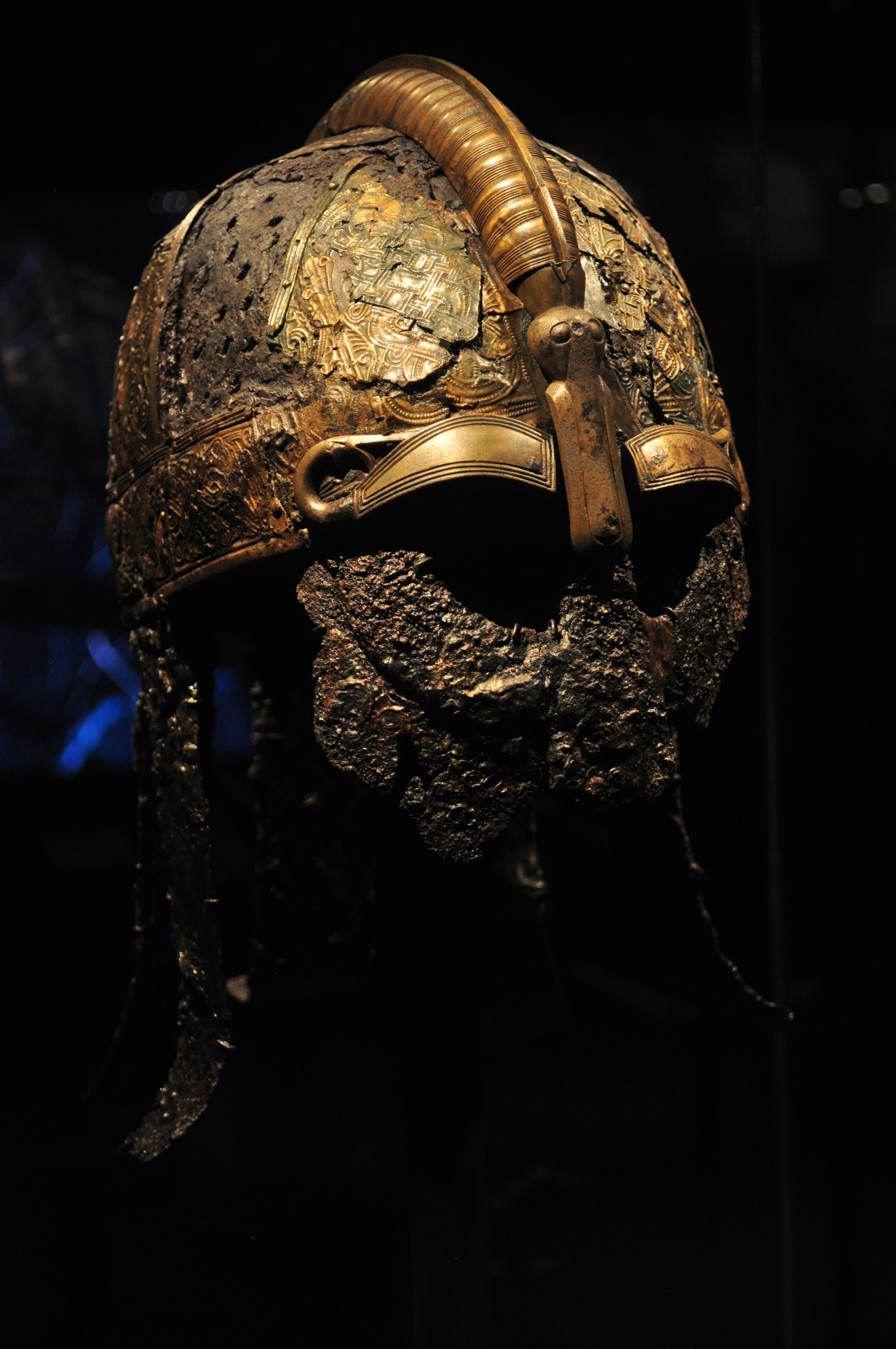
Photos: Joe Mabel et al. · Model: Åkerlund/Sjöhistoriska (CC BY) · Drawings: Faith-Ell, Fridell 1930, Ljungkvist 2008, Nordahl 2018, Schönbäck/Gustavianum (via DiVA) · licence/credit per image · Commons
Knowledge
How was the site excavated?
You have seen objects and drawings. That is possible because many boat graves were essentially unplundered when excavated — and because the digs were recorded with plans, sections and photographs. The burial ground was discovered in the 1920s. Uppsala University excavated under Sune Lindqvist in 1928–1936 and again after the war (1946–1952). The objects are kept at Gustavianum; a digital catalogue and georeferenced plan are in ALVIN.
Classic monographs (especially Greta Arwidsson on boats 6, 7 and 8) and later research (including Ljungkvist and Nordahl) underpin what you read in popups and the image viewer. Where something is uncertain we say so — rather than letting exhibition labels stand as fact.
Landscape
Same valley – three sites
The graves sit in the same fairway as the power centre at Old Uppsala. Zoom out — three sites in one valley.
The Fyris River – the big map
Land uplift, fairway and power places from Flottsund to Old Uppsala – with Valsgärde in focus. Part of the same landscape as the Battle of Fyrisvellir.
On site
Visiting Valsgärde
Want to stand where the graves lay? The burial ground is at Valsgärde, north of Old Uppsala, east of the Fyris River. It is a protected archaeological landscape — not a museum building on the hill. Respect the ground and monuments; do not dig or move stones.
The best-known objects are on display at Gustavianum (Uppsala University). Digital records and plan material are in ALVIN.
Directions with GPS · the hill east of the Fyris River
Read more
Sources and further reading
For those who want to dig deeper — a short list, not a full bibliography. Detail on individual finds and graves is in the popups and image viewer.
- Arwidsson, G. Valsgärde 6 (1942); Valsgärde 8 (1954); Valsgärde 7 (1977) — monographs on the great Vendel boats.
- Fridell, A. (1930). Den första båtgraven vid Valsgärde. Fornvännen — classic plans (open via DiVA/RAÄ).
- Ljungkvist, J. (2008). Valsgärde – development and change… In: Valsgärde Studies — chronology and field overview (PDF).
- Nordahl, E. (2018). Valsgärde 14 — modern monograph with drawings (PDF).
- Gustavianum / ALVIN — collections and digital record: The Valsgärde Gravesite.
- Wikimedia Commons — photos (incl. Joe Mabel, CC BY-SA 4.0) and occasional plates: Category: Archaeological finds from Valsgärde.