Hoppa till innehåll
C. 985 AD • GAMLA UPPSALA

Styrbjörn the Strong

The Battle of Fyrisvellir

The most complete reconstruction • Runic script • English text with Younger Futhark • Historical images

Introduction

A saga in stone, memory and runes

This is the most detailed digital reconstruction of the history of Styrbjörn the Strong that can be created. Here you will find all preserved primary sources, full runic inscriptions displayed in authentic Younger Futhark, normalized Old West Norse, transliteration, with full English translations. The page has been expanded with additional historical context, political background, more about the Jomsvikings, and the aftermath of the battle.

The text is structured for maximum readability with generous spacing, clear hierarchies, and deep dives into every detail. Historical images have been added to provide a more evocative visual experience of the Viking Age world.

Svitjod and Denmark in the Late Viking Age

During the late 10th century, Scandinavia underwent a profound consolidation phase. The old regional petty kingdoms were compressed under stronger, centralized kingdoms. In Denmark, Harald Bluetooth had successfully unified the realm and introduced Christianity, which he had carved on the famous Jelling Stone [1]. In Svealand, or Svitjod, royal power was still deeply bound to the ancient pagan rites in Uppsala and the assembly (Ting), where the common people demanded their influence. Control over the lucrative Baltic Sea trade routes created a latent conflict between the expanding Danish empire and the kings of the Svear. It was in this turbulent era of transition between Norse paganism and Christianity, between centralized monarchy and decentralized clan structures, that the drama of Styrbjörn the Strong unfolded.

Chapter I

The Prince's Wrath

During a time when the Yngling dynasty still held court in Gamla Uppsala, two brothers ruled—Erik the Victorious (Segersäll) and Olof Björnsson—sons of Björn the Old, according to Styrbjarnar þáttr Svíakappa (preserved in the Flateyjarbók from around 1390). The realm was still fragmented, and power rested on a fragile balance between royal authority and the powerful farmers of Uppland.

Styrbjörn was the son of Olof Björnsson of the Yngling dynasty, who reigned around 970–975. His father Olof's father, in turn, was the King Björn mentioned in Rimbert's chronicle of the life of Ansgar, a king who enjoyed an exceptionally long reign on the throne. Olof shared the co-rulership of Svitjod with his brother Erik, the future Victorious, and died according to the Flateyjarbók from a "snakebite"—a traditional euphemism suggesting he may have been poisoned or assassinated by his brother, who coveted sole rule over the realm.
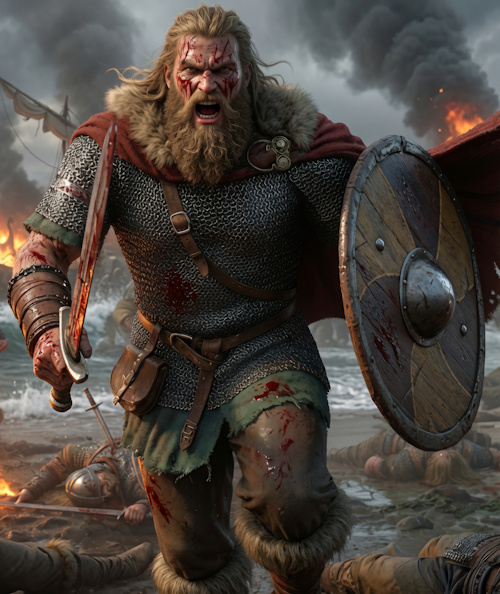
Konstnärlig gestaltning av Styrbjörn Starke i strid – vikingaprins med sköld och svärd
An artistic rendering of how the indomitable Styrbjörn the Strong may have appeared—a hardened warrior-prince fueled by wrath and pride.

Styrbjörn—who at this time was simply called "Björn" plain and simple—grew up at his uncle's royal estate as a concubine's son (*frilloson*), but for obvious reasons, he refused to content himself with being an overlooked prince in the shadow of power. He believed he possessed the same inherent right to the kingdom as his father, and by the age of twelve, he often sat upon his father's burial mound—an ancient Norse legal claim—and demanded his inheritance. He repeated the demand three years in a row. Erik, a cunning politician, replied that the boy was not mature enough until he reached sixteen. Tension between the uncle and nephew mounted.

The following year, Björn appeared at the great Disting assembly in Uppsala, just thirteen years of age, accompanied by Jarl Ulf. Ulf was likely Erik's governor over Västergötland and the key Göta provinces—regions where Styrbjörn would later find his strongest domestic support. However, he was politically outmaneuvered at the assembly, and the Uppland farmers declared him unfit to take part in the co-rulership until he reached sixteen. At sixteen, a political settlement was reached with King Erik, who summoned the *ledung* (naval levy) and drew from the resources of *Uppsala öd*—the crown estates reserved for national defense that belonged personally to the king of Uppsala. Styrbjörn was granted a fleet of no fewer than 60 fully equipped war-drakes. With at least 32 rowing benches per vessel (translating to a crew of at least 64 warriors per ship), Styrbjörn commanded a force of 3,840 men. This comprised a major portion of the entire national mobilization, which at the time is estimated to have totaled around 6,000 well-armed warriors.

Sitting on a Burial Mound (At sitja á haugi)

Sitting on an ancestor's burial mound was a vital legal and sacral act during the Viking Age. It served as a public proclamation of inheritance and claims to power (*haugóðal*). By physically sitting on Olof Björnsson's mound, the young Björn demonstrated his claim to co-rulership, as custom dictated in Svitjod. His uncle Erik the Victorious opposed this, arguing that Björn's violent and erratic temperament made him unfit to lead the Svear. Erik preferred a unified realm under a single monarch over the ancient system of divided rule, laying the groundwork for the inevitable confrontation.

→ Full childhood account from Styrbjarnar þáttr Svíakappa

According to the Flateyjarbók, during his youth, Styrbjörn was playing with a retainer named Åke at King Erik’s court and threw a cloak over him. In the ensuing scuffle, Åke struck Björn across the nose with a heavy drinking horn. Enraged by the pain and humiliation, Björn slew Åke outside the hall. The *mansbot* (weregild) required for the killing was delivered by Björn directly to King Erik, bypassing Åke's relatives entirely. This made it abundantly clear that he was a self-willed prince who recognized only the supreme authority of the king, indicating early on that he would be a dangerous and difficult man to deal with.

At the assembly (Ting), the free farmers ruled in Erik's favor. Erik gave him sixty fully equipped longships and sent him away for three years "to prevent civil unrest". This was both a punishment and a golden opportunity. Björn departed Svitjod as an exiled prince—but with a formidable fleet.

According to the saga, Björn accepted the fleet with the words: "If I cannot rule the land of my fathers, I shall claim my destiny upon the waves." It was during these three years that he cleared the seas and gathered enough military might and wealth to eventually challenge the rulers of the north. He subjugated Bornholm and raided along the Pomeranian coast, where he quickly drew the attention of local chieftains.
Chapter II

Jomsborg – Rulers of the Baltic

Styrbjörn first sailed eastward, securing the Gulf of Finland for his own and the Svea king's interests, before sailing on to Holmgård (Novgorod) in Gårdarike (often termed *Svitjod hin mikla*—"Great Svitjod"—in the Icelandic sagas of the era). By the age of eighteen, he was reportedly acclaimed as king in Holmgård, earning formal recognition from the Rurikid princely house of Kiev, the mightiest of all the Rus'. Perhaps the young pretender defined his life's philosophy in the same spirit as King Magnus Barefoot of Norway and Scotland would declare centuries later: "I have come to you as a war king, not a stool king. Kings are not put into this world to live long lives, but to win glory and achieve eternal renown."

Upon turning twenty, Styrbjörn arrived at Jomsborg. This phase is uniquely well-documented across four independent sources: *Flateyjarbók*, *Hervarar saga*, *Eyrbyggja saga*, and Saxo Grammaticus's *Gesta Danorum*. At this time, Jomsborg was ruled by Palnatoke, Jarl of Scania and a trusted confidant of Harald Bluetooth. Though skaldic poetry implies Styrbjörn took the fortress by force, he and Palnatoke quickly formed a close alliance.

The Historical and Archaeological Enigma of Jomsborg

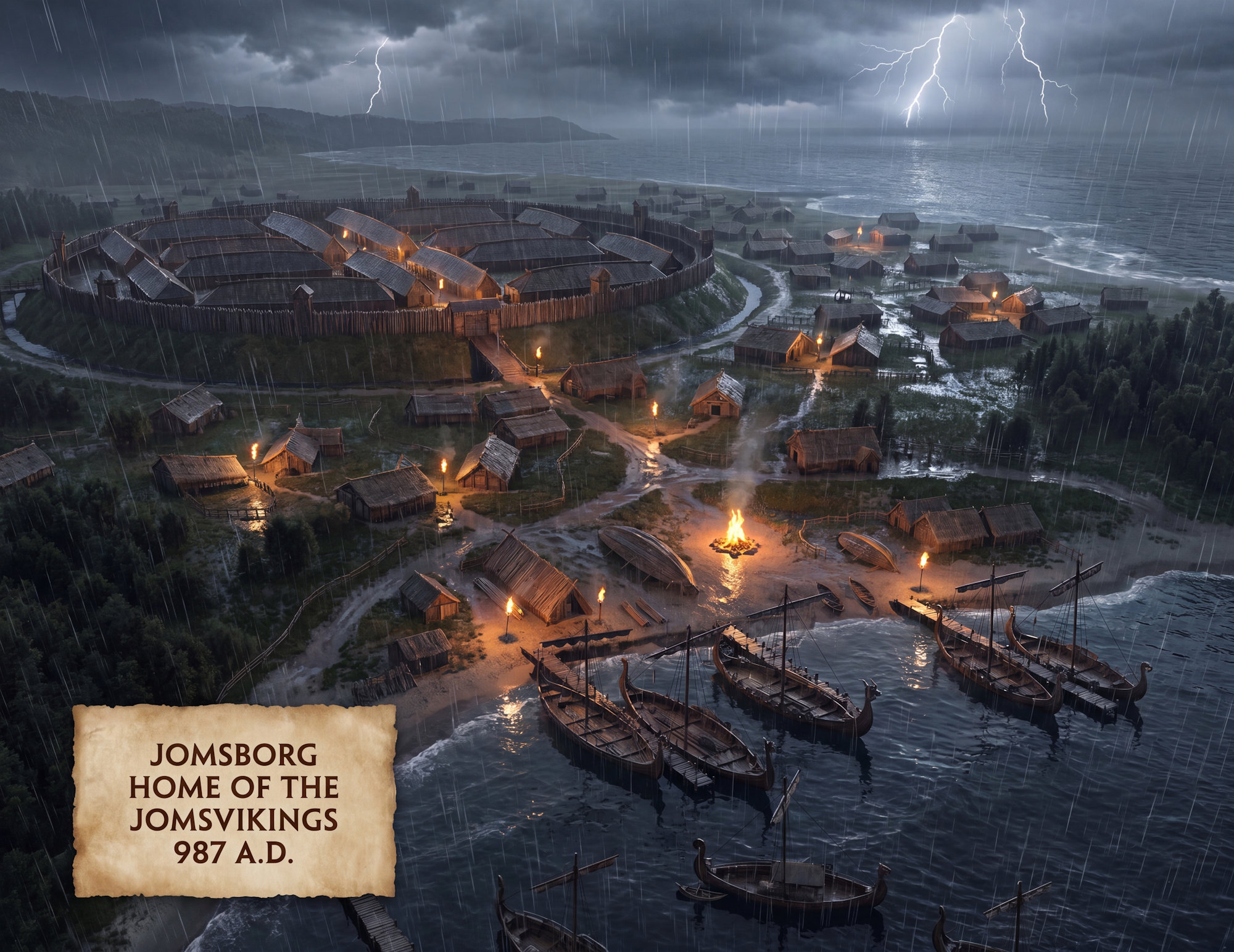
The exact geographical location of Jomsborg has long been a subject of scholarly debate. The prevailing theory among modern archaeology identifies the fortress with the fortified trade hub of Wolin at the mouth of the Oder River in present-day Poland. Excavations there have revealed massive wharf constructions, a large circular wall, and warrior graves with Scandinavian elements. The Jomsvikings functioned as an elite force whose services were purchased by the Baltic's most powerful monarchs. When the young, exiled prince Björn appeared at the fortress walls, it was not as a beggar but as a feared warlord whose military successes forced the jarl of the Jomsvikings to submit.

Dramatiskt vikingalandskap med hav och klippor – symbol för Jomsvikingarnas värld
The harsh Baltic coastline—the world dominated by the Jomsvikings during the latter half of the 10th century.
→ Laws and organization of the Jomsvikings
• No one under 18 or over 50 years of age was allowed membership
• No women were permitted within the fortress walls
• All plunder was to be divided strictly equally
• Anyone who fled from battle was severely punished
• Every man was duty-bound to avenge his fallen comrade
• No one was allowed to speak ill of another in the retinue
• Absolute discipline was demanded—the Jomsvikings were professional soldiers
Laws from the Jómsvíkinga saga: No one was allowed to carry gossip or spread rumors; all plunder, large or small, had to be brought to the common hoard on pain of death. No one could harbor personal grudges that disrupted the cohesion of the brotherhood. Any internal disputes were judged solely by the jarl or the king. Violating the code meant immediate expulsion and shame—or death by being cast from the fortress cliffs.

Styrbjörn entered into a powerful political alliance with the Danish king, Harald Bluetooth (Gormsson). He married Harald's daughter Tyra. Meanwhile, Styrbjörn's sister Gyrid was wed to the aging Danish king. This double marriage alliance bound the two leaders together in a shared interest to weaken the Swedish realm. Styrbjörn's sister, Gyrid, had been with him throughout the journey. Jarl Toke proposed that she marry Harald Bluetooth of Denmark, who was now an old man but still fond of women. This occurred in the year 984 AD, while Styrbjörn married Tyra Haraldsdotter (who had previously been married to Olaf Tryggvason and would have been around 24 years of age).

Styrbjörn's fortune was now made. He ruled over Finland, Scania, Gårdarike, the Baltic lands, and Poland, while being closely allied with Denmark, the leading Baltic power of the era. Had he succeeded in preserving this dominion, the entire history of Scandinavia and Northern Europe would have looked vastly different. However, Styrbjörn now desired to settle scores with his uncle Erik in Svitjod—the only power that still stood against him.

Harald Bluetooth saw Styrbjörn as the perfect instrument to expand Danish hegemony over Svealand. If Styrbjörn succeeded in deposing Erik the Victorious, Denmark would secure a grateful vassal king in Uppsala. The alliance was sealed with gold, promises of military aid, and a massive fleet of several hundred longships, ready to crush the resistance of the Svear. According to Saxo, Styrbjörn commanded a fleet of 200 war-drakes, which would translate to a force of at least 12,800 men.

Sweyn Forkbeard's Rebellion and the Danish Betrayal

Behind Harald Bluetooth's sudden retreat at Lake Mälaren lay not just personal hesitation, but a profound domestic crisis in Denmark. Harald's son, Sweyn Forkbeard, had launched a violent rebellion against his father in alliance with chieftains who opposed the forced Christianization of the realm. This internal strife crippled Harald's military capacity. When news reached King Harald that Sweyn's fleet threatened the Danish home islands, he was forced to recalculate: committing his core forces to a risky campaign deep within Svitjod was impossible while his own crown hung in the balance. Styrbjörn's fate was thus sealed in the forests of Scania and Zealand long before the first spears were thrown in Uppsala.

Chapter III

The Battle of Fyrisvellir

In the year 985 (or possibly 984/986 depending on different datings), Styrbjörn gathered an invasion force. The core was composed of Jomsvikings from Jomsborg, reinforced by Danish troops led by Toke Gormsson (Valtóki), son of Gorm the Old and brother of Harald Bluetooth, as well as other chieftains like Sibbe the Good.

When the fleet reached Lake Mälaren, King Harald Bluetooth turned back. The reason remains unclear—perhaps a cold political calculation, or fear of committing fully to a Swedish civil war. Styrbjörn was left to stand alone with his most loyal men. According to Saxo, Harald Bluetooth and the Danes had originally intended to launch an attack over Halmstad and up along the Nissastigen path, reflecting the classical tactics deployed during Saxo's own 13th century prior to the famous battles of Kungslena and Gestrilen.

It was then that he made his most dramatic decision: he ordered all longships to be burned. The flames and thick black smoke were visible all the way to the royal estate in Uppsala. For his men, only two options remained—victory or Valhalla. No way back across the sea existed anymore. He executed this burning down at the river's mouth, clearly illustrating to his men that they faced only victory or death.

According to the Polish chronicles from the 990s (penned by the chaplain Avico), Styrbjörn commanded 24 longships (around 1,536 men). Additionally, there were 17 ships under Sibbe the Good of Zealand (another 1,088 men) arranged by Jarl Toke, as well as the Scanians with 13 ships (832 men) and the Jomsvikings with another 13 ships (832 of the finest, most elite warriors available). This totals a force of at least 4,288 men—a far more plausible figure than Saxo's estimates. Swedish historians suggest Styrbjörn had around 5,000 men under his command when the battle took place in the early summer of 985 AD.

Three Days of Slaughter

The saga recounts that the battle on the marshy plains south of Gamla Uppsala lasted for three days. At Fyrisvellir, Styrbjörn found his target—his uncle Erik and his men, who had quickly arranged themselves in wedge-shaped battle formations (*fylkingar*):
Day 1: Styrbjörn's army made a violent advance. They breached the Svear's outer defensive lines along the Fyris River. Although Erik had blocked the waterway with wooden stakes and sunken vessels, the invasion force managed to land and establish their shield-wall camp. The day's fighting ended inconclusively, but casualties were immense on both sides.
Day 2: Erik the Victorious received reinforcements from the Uppland hundreds (*hundare*). Styrbjörn ordered his Jomsvikings to form an impenetrable shield castle, which the Svear tried in vain to shatter. Towards evening, Erik realized the situation was critical. He went to the Temple of Odin in Uppsala to seek divine guidance.
Day 3: After sacrificing to Odin and pledging his soul to the god after ten years, Erik returned to the battlefield. As the conflict reached its peak, the king cast his spear over the enemy host and cried the legendary words. (The battle took place in 985 AD and Erik the Victorious indeed died ten years later, in 995 AD). Styrbjörn's host, for their part, called upon the god Thor during the clash.

“Odin owns you all!” — the words Erik the Victorious is said to have cried as he cast his spear over the enemy on the third day.

After the third day of combat commenced, the Svear proved superior, and many Danish warriors turned and fled from the Swedish viking steel—an event recorded in the Skjöldunga saga. Styrbjörn the Strong fell in the midst of the carnage. But what defines the legend is what happened afterward: Styrbjörn, his retainer Erra (Ärre), and other sworn brothers refused to flee. Toke Gormsson and his closest retainers stayed to fight to the very end until the weapons fell from their hands—loyal unto death. This is what the runestones later celebrate with the words "He did not flee at Uppsala."

According to the Polish chronicle, it had been originally agreed that Jarl Toke would be the supreme ruler of the new realm to be founded after their victory, while Styrbjörn would merely be appointed as a Danish vassal jarl over the Swedish kingdom. But fate decreed otherwise.

The Leiðangr System and the Defense of Svitjod

Erik the Victorious' success relied not only on tactical genius or religious rites, but on the efficient mobilization of the *leiðangr* (conscription system). By lighting signal beacons along the coasts of Uppland and Södermanland, a network of defensive "hundreds" (*hundare*) was activated. Each region was obligated to supply a set number of ships and fully equipped freeholders. This regional militia heavily outnumbered Styrbjörn’s invasion force, ensuring that the Jomsvikings' elite training was ultimately crushed under a relentless wave of fresh defenders. It marked the turning point where traditional Viking raiding hosts were defeated by a structured, territorial national defense.

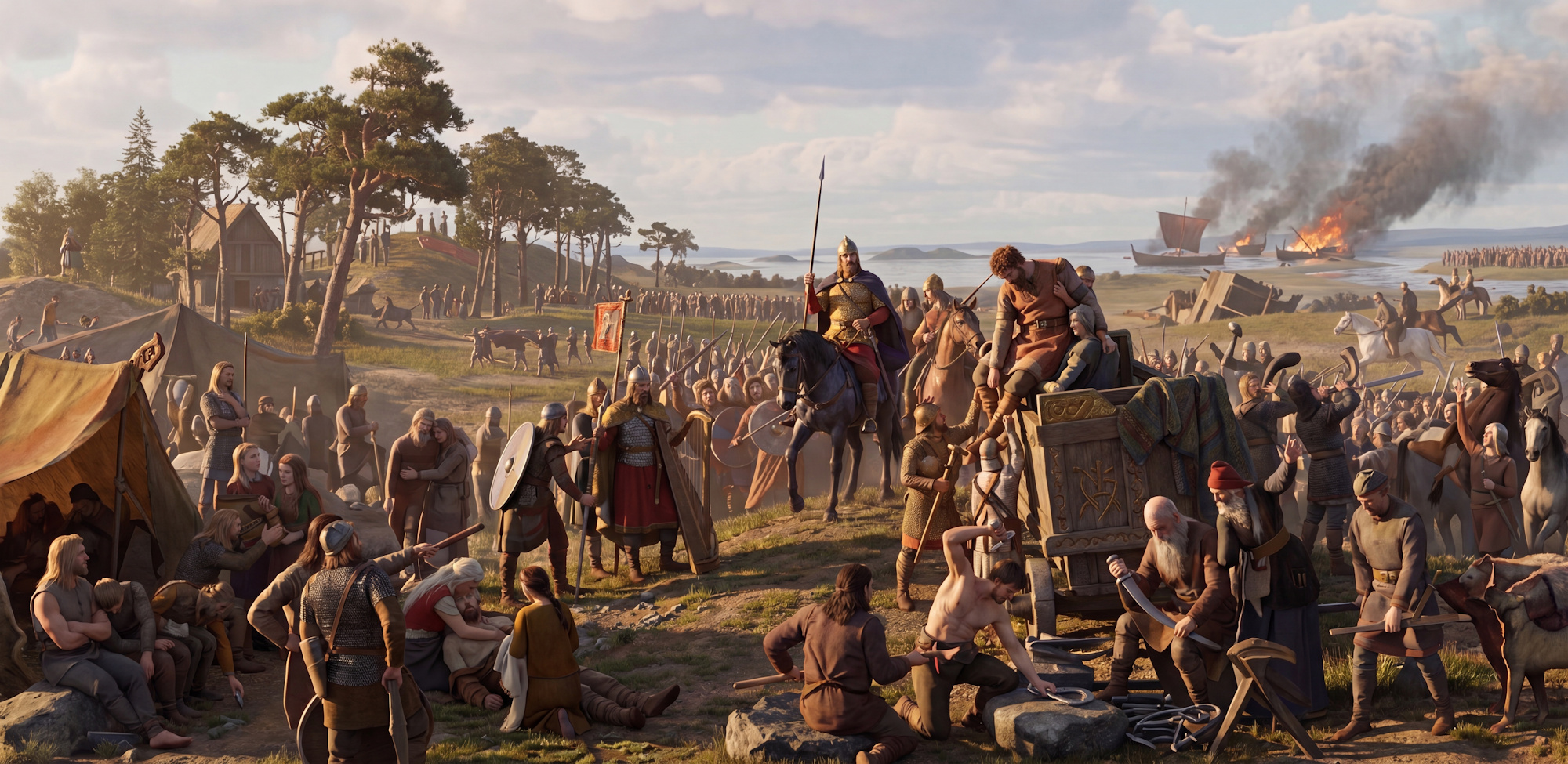
Modern tolkning av Mårten Eskil Winges målning Efter slaget vid Fyrisvall – panorama med segerherre, sårade och brinnande skepp
Modern interpretation of Mårten Eskil Winge’s proposed wall decoration for the upper hall of the Nationalmuseum: “After the Battle of Fyrisvall” (NM 4002). A romantic 19th-century vision — not an archaeological reconstruction.
Epilogue

The Runestones – The Contemporary Runic Memory

The strongest contemporary sources of the battle are the Scanian and Ölandic runestones. Erected within a generation of the events, they explicitly mention the battle at Uppsala and the men who "did not flee." Here they are presented in authentic Younger Futhark with complete translations.

Karlevistenen på Öland – en av de viktigaste runstenarna kopplade till Styrbjörns allierade
The Karlevi Runestone on Öland, raised in memory of Sibbe the Good—one of Styrbjörn's allied Jomsvikings. The stone bears one of the most beautiful surviving dróttkvætt stanzas.
SJÖRUPSTENEN (DR 279) • SKÅNE
Raised in memory of Ásbjörn, son of Tóki Gormsson
RUNSKRIFT (Younger Futhark)
ᛋᛅᛦᛁ : ᛋᛅᛏᛁ : ᛋᛏᛁᚾ : ᚦᛅᛋᛁ : ᛅᚠᛏᛁᛦ : ᛅᛋᛒᚢᚱᚾ : ᛋᚢᚾ : ᛏᚢᚴᛅ : ᚠᛁᛚᛅᚷᛅ : ᛋᛁᚾ : ᛋᛅ : ᚠᛚᚢ : ᛅᛁᚷᛁ : ᛅᛏ : ᚢᛒᛋᛅᛚᚢᛘ : ᛁᚾ : ᚢᛅ : ᛘᛅᚦ : ᚢᛅᛒᚾᚢᛘ
TRANSLITTERATION
saxi : sati : stin : þasi : aftir : asburn : sun : tuka : felaga : sin : sa : flo : aigi : at : Upsalum : en : ua : maþ : uabnum
NORMALIZED OLD WEST NORSE
Saxi setti stein þenna eptir Ásbjǫrn, son Tóka, félaga sinn. Sá fló eigi at Uppsǫlum en vá með vápnum.
SWEDISH TRANSLATION
Saxi raised this stone after Ásbjörn, Tóki's son, his félagi (companion). He did not flee at Uppsala but fought as long as he had weapons.
ENGLISH TRANSLATION
Saxi raised this stone in memory of Ásbjörn, Tóki’s son, his companion. He did not flee at Uppsala but fought as long as he had weapons.
Historical Commentary: Note the word *félagi* (the root of the English word *fellow* and Swedish *bolag*), which specifically referred in this era to a partner or joint owner who shared movable property—such as warships—with another. While Norwegian sources (like the 15th-century Flateyjarbók) claim that all Jomsvikings stood ground while the Scanians fled, this is directly refuted by the Scanian runestones. These four monuments repeatedly declare the same heroic message, mirroring the Greek epitaph of Thermopylae: "Tell those at home, stranger passing by, that here, obedient to our laws, we lie."
HÄLLESTADSTENARNA (DR 295) • SKÅNE
Hällestad I - Raised in memory of Tóki Gormsson by Áskell
RUNSKRIFT (DR 295)
ᛅᛋᚴᛁᛚ : ᛋᛅᛏᛁ : ᛋᛏᛁᚾ : ᚦᛅᚾᛋᛁ : ᛁᚠᛏᛁᛦ : ᛏᚢᚴᛅ : ᚴᚢᚱᛘᛋ : ᛋᚢᚾ : ᛋᛅᛦ : ᚢᛚᛅᚾ : ᛏᚱᚢᛏᛁᚾ : ᛋᛅᛦ : ᚠᛚᚢ : ᛅᛁᚷᛁ : ᛅᛏ : ᚢᛒᛋᛅᛚᚢᛘ
TRANSLITTERATION
askil : sati : stin : þansi : iftiʀ : tuka : kurms : sun : saʀ : hulan : trutin : saʀ : flu : aigi : at : upsalum
NORMALIZED OLD WEST NORSE
Áskell setti stein þenna eptir Tóka Gorms son, sér hollan dróttin. Sá fló eigi at Uppsǫlum.
SWEDISH TRANSLATION
Áskell raised this stone in memory of Tóki, Gorm's son, his faithful lord. He did not flee at Uppsala.
ENGLISH TRANSLATION
Áskell raised this stone in memory of Tóki, Gorm’s son, his faithful lord. He did not flee at Uppsala.
Historical Commentary: This stone explicitly names Tóki as "Gorm's son", making him the brother of Harald Bluetooth and thus a Danish prince. This proves that the highest echelons of the Danish royal house personally participated in the expedition.
HÄLLESTADSTENARNA (DR 296) • SKÅNE
Hällestad II - Raised by Ásgautr in memory of his brother Erra
RUNSKRIFT (DR 296)
ᛅᛋᚴᛅᚢᛏᚱ : ᚱᛁᛋᚦᛁ : ᛋᛏᛁᚾ : ᚦᛅᚾᛋᛁ : ᛁᚠᛏᛁᛦ : ᛁᚱᚢ : ᛒᚱᚢᚦᚢᛦ : ᛋᛁᚾ : ᛁᛦ : ᚢᛅᛋ : ᛏᚢᚴᛅ : ᚼᛁᛘᚦᚽᚷᛁ : ᚾᚢ : ᛋᚴᛅᛚ : ᛋᛏᛅᚾᛏᛅ : ᛋᛏᛁᚾ : ᚢ : ᛒᛁᛅᚱᚴᛁ
TRANSLITTERATION
asgautr : risþi : stin : þansi : iftiʀ : iru : bruþur : sin : iʀ : uas : tuka : himþægi : nu : skal : stanta : stin : o : biarki
NORMALIZED OLD WEST NORSE
Ásgautr reisti stein þenna eptir Erra, bróður sinn, er vas Tóka heimþegi. Nu skal standa steinn á bergi.
SWEDISH TRANSLATION
Ásgaut raised this stone in memory of his brother Erra. He was Tóki's retainer. Now the stone shall stand on the hill.
ENGLISH TRANSLATION
Ásgautr raised this stone in memory of Erra, his brother, who was Tóki’s retainer. Now the stone shall stand on the hill.
Historical Commentary: This stone uses the term *heimþegi* (home-receiver/retainer), referring to a warrior who received a dwelling, weapons, or land from his lord in exchange for loyal service. The declaration that the stone "shall stand on the hill" indicates it was raised on a highly visible, elevated point in the Scanian landscape.
HÄLLESTADSTENARNA (DR 297) • SKÅNE
Hällestad III - Raised by Ásbjörn in memory of his brother Tóki
RUNSKRIFT (DR 297)
ᛅᛒᛁᚢᛦᚾ : ᚼᛁᛘᚦᚽᚷᛁ : ᛏᚢᚴᛅ : ᛋᛅᛏᛁ : ᛋᛏᛁᚾ : ᚦᛅᛋᛁ : ᛁᚠᛏᛁᛦ : ᛏᚢᚴᛅ : ᛒᚱᚢᚦᚢᛦ : ᛋᛁᚾ
TRANSLITTERATION
osbiurn : him:þaki : tuka : sati : stin : þasi : iftiʀ : tuka : bruþur : sin
NORMALIZED OLD WEST NORSE
Ásbjǫrn, heimþegi Tóka, setti stein þenna eptir Tóka, bróður sinn.
SWEDISH TRANSLATION
Ásbjörn, Tóki's retainer, placed this stone in memory of his brother Tóki.
ENGLISH TRANSLATION
Ásbjörn, Tóki's retainer, placed this stone in memory of Tóki, his brother.
Historical Commentary: Together, the three Hällestad stones formed a grand familial and military monument. They confirm that the men who fought under Tóki Gormsson were a tightly knit warrior band bound by deep fraternal oaths.
KARLEVISTENEN (ÖL 1) • ÖLAND
Raised in memory of Sibbe the Good – one of Styrbjörn's allied Jomsvikings
SKALDIC VERSE (DRÓTTKVÆTT) IN RUNIC SCRIPT
ᚠᚢᛚᚴᛁᚾ : ᛚᛁᚴᛦ : ᚼᛁᚾᛋ : ᚠᚢᛚᚴᚦᚢ :
ᚠᛚᛅᛋᛏᛦ : ᚢᛁᛋᛁ : ᚦᛅᛏ : ᛘᛅᛋᛏᛅᛦ :
ᛏᛅᚦᛁᛦ : ᛏᚢᛚᚴᛅ : ᚦᚱᚢᚦᛅᛦ :
ᛏᚱᚢᛏᛦ : ᛁ : ᚦᛅᛁᛘᛋᛁ : ᚼᛅᚢᚴᛁ ;
ᛘᚢᚾᛅᛏ : ᚱᛅᛁᚦ:ᚢᛁᚦᚢᛦ : ᚱᛅᚦᛅ :
ᚱᚢᚴᛋᛏᛅᚱᚴᛦ : ᛁ : ᛏᛅᚾᛘᛅᚱᚴᚢ :
ᛅᛏᛁᛚᛋ : ᛁᛅᚱᛘᚢᚾᚴᚱᚢᚾᛏᛅᛦ :
ᚢᛦᚴᚱᛅᚾᛏᛅᚱᛁ : ᛚᛅᚾᛏᛁ .
TRANSLITTERERING (VERS)
fulginn liggʀ hinns fylgðu,
flæstr vissi þat, mæstaʀ
dæðiʀ dolga Þruðaʀ
draugʀ i þæimsi haugi;
munat Ræið-Viðurr raða
rogstarkʀ i Danmarku
Endils iarmungrundaʀ
urgrandari landi.
NORMALISERAD FORNVÄSTNORDISKA
Fulginn liggr, hins fylgðu,
flæstr vissi þat, mæstar
dæðir dolga Þrúðar
draugr í þeimsi haugi;
munat Reið-Viðurr ráða
rógstarkr í Danmarku
Endils iarmungrundar
urgrandari landi.
SWEDISH TRANSLATION
Hidden lies he who followed the greatest deeds – most men knew it – the worker of the goddess of battles in this mound. A more righteous, battle-strong man shall not rule over land in Denmark on the sea-king’s vast domain.
ENGLISH TRANSLATION
Hidden lies he who followed the greatest deeds – most men knew it – the worker of the goddess of battles in this mound. A more righteous, battle-strong man shall not rule over land in Denmark on the sea-king’s vast domain.
Skaldic Analysis: The Karlevi runestone bears the only complete surviving *dróttkvætt* stanza carved in runes. The stanza is filled with complex kennings: "Trud of battles" (the battle goddess Þrúðr, Thor's daughter) and her "worker" (draugr/warrior) refers to the fallen leader. "Reið-Viðurr" means "Chariot-Odin" (a metaphor for sea-captain or warlord), and "Endil's vast ground" denotes the ocean. It praises Sibbe as a highly righteous ruler of Danish lands, showing the close geopolitical and military links between Öland, Scania, and the Danish crown.
HÖGBYSTENEN (ÖG 81) • ÖSTERGÖTLAND
Erected in memory of Gulli's sons; Åsmund fell at the "Fœri"
RUNSKRIFT (Sida B - versifierad del)
ᚴᚢᚦᚱ * ᚴᛅᚱᛚ * ᚴᚢᛚᛁ * ᚴᛅᛏ * ᚠᛁᛘ * ᛋᚢᚾᛁ * ᚠᛁᛅᛚ * ᚢ * ᚠᚢᚱᛁ * ᚠᚱᚢᚴᚾ * ᛏᚱᛁᚴᛋ * ᛅᛋᛘᚢᛏᚱ * ᛅᛁᛏᛅᚦᛁᛋ * ᛅᛋᚢᛦ * ᛅᛢᛋᛏᚱ * ᛁ * ᚴᚱᛁᚴᚢᛘ * ᚢᛅᛦ * ᚢ * ᚼᚢᛚᛘᛁ * ᚼᛅᛚᚠᛏᛅᚾ * ᛏᚱᛁᛒᛁᚾ * ᚴᛅᚱᛁ * ᚢᛅᛦ * ᛅᛏ * ᚢᛏᛁ
TRANSLITTERATION
kuþr * karl * kuli * kat * fim * syni * feal * o * furi * frukn * treks * asmutr * aitaþis * asur * austr * i krikum * uarþ * o hulmi * halftan * tribin * kari * uarþ * at uti
NORMALIZED OLD WEST NORSE
Góðr karl Gulli gat fimm sonu. Fjall á Fœri frœkn drengr Ásmundr, endaðis Ǿzurr austr í Grikkjum, varð á Holmi Halfdan drepinn, Kári varð at uti...
SWEDISH TRANSLATION
The good husbandman Gulli got five sons. The brave doughty man Ásmundr fell at Fœri; Ǿzurr met his end in the east in Greece; Halfdan was killed at Holmr; Kári died abroad; and dead is also Búi.
ENGLISH TRANSLATION
The good husbandman Gulli got five sons. The brave doughty man Ásmundr fell at Fœri; Ǿzurr met his end in the east in Greece; Halfdan was killed at Holmr; Kári died abroad; and dead is also Búi.
Historical Commentary: The Högby Runestone is one of Sweden's most famous monuments. The expression "feal o furi" (fell at Fœri/Fyris) is widely accepted by runologists as referring directly to Fyrisvellir in Uppsala. The reverse side of the stone forms a tragic chronicle of an entire brotherhood that perished across different far-flung battlefronts at the close of the 10th century.
Appendix A

Complete Primary Sources

Styrbjarnar þáttr Svíakappa – The Main Narrative
The full text is preserved in Flateyjarbók. It describes Styrbjörn's childhood, his journey to Jomsborg, the alliance with Harald Bluetooth, the burning of his own ships, and the final battle with its miraculous animal tempest and Odin-vow. Many details are literary motifs found across several 1300s Icelandic sagas.

The narrative bears clear traces of mythological overlay, especially Erik's devotion to Odin. It describes how Odin presented Erik with a simple reed/cane, instructing him to throw it over the enemy ranks while shouting his vow. Upon being cast, the reed transformed in mid-air into a burning spear of terror, blinding the invasion host. Literary scholars view this as a clear reflection of ritual battle-initiations associated with the cult of Odin.

Saxo Grammaticus – Gesta Danorum (Book 10)
A more pro-Danish account where Styrbjörn is depicted as pleading with Harald for aid. Harald conquers Julin (Jomsborg) and bestows it upon Styrbjörn. Styrbjörn then sails alone to Sweden after Harald is forced to withdraw to defend the Danish southern border against German encroachment.

Saxo presents Styrbjörn in a somewhat more tragic yet highly heroic light. According to Saxo, Emperor Otto II's campaigns against the Danevirke were the primary reason Harald Bluetooth was forced to abandon his son-in-law. The acute geopolitical threat from the Holy Roman Empire to the south forced the Danes to prioritize their border defense, leaving Styrbjörn stripped of vital Danish reinforcements at Uppsala.

Gesta Wulinensis – The Newly Discovered Testament (Recent Find)
The recently highly debated Latin manuscript *Gesta Wulinensis* (penned in the 990s by Harald Bluetooth's personal chaplain Avico) sheds new light on the conflict. The text describes the Battle of Fyrisvellir in 986, confirming that Harald Bluetooth's withdrawal was driven not by cowardice but by the urgent threat of German invasions in southern Denmark. This source solidifies the connection between the Scanian runestones and the actual historical campaign, offering a cohesive geopolitical picture of the war.
Appendix B–E

Extended Studies & Tactical Estimations

Historiography

19th-century romantic hero sagas (Verner von Heidenstam et al.) → 20th-century historical source criticism → Modern runological and interdisciplinary research where runestones are treated as the strongest contemporary physical evidence of a grand battle near Uppsala around 985.

Weibullian source critics (such as brothers Lauritz and Curt Weibull) stripped away the fantastic elements of 13th-century sagas. Today, however, scholars apply a more balanced, interdisciplinary method, viewing the harmonious testimony of the runestones about "not fleeing at Uppsala" as credible physical evidence of a major late 10th-century clash.

Geography & Archaeology

The Fyrisvellir plains are believed to be the flat, marshy lands south of Gamla Uppsala, close to the Fyris River. Jomsborg is commonly identified as Wolin on the Oder River in Poland. While no mass graves have yet been linked to this specific clash, the runestones remain our most robust material evidence.

Archaeological investigations around Gamla Uppsala in recent decades have revealed a monumental system of wooden post rows running across the landscape, dated to the late 10th century. This massive wooden palisade likely formed part of the tactical defenses constructed by Erik the Victorious to block and funnel the invaders' advance from the riverbank.

North of the royal mounds, east of the Fyris River, lies Valsgärde – about 3 km north of Gamla Uppsala – with roughly 90 burials and 15 boat graves (Vendel–Viking Age). It reflects the elite riverine landscape the saga presupposes, without the boat graves themselves dating or proving the battle of 985. (A full guide page will be published separately.)

→ Interactive map: battle path (6 steps) → Valsgärde on the Fyris map

Appendix E: Estimated Troop Strengths & Ratios

The following visual model displays military ratios at the battle in 985 AD, weighing Uppsala's royal levy (Leiðangr) against the contemporary, far more realistic records of the Pomeranian court chaplain Avico regarding Styrbjörn's actual forces (over Saxo Grammaticus's exaggerated literary estimates).